We are committed to sharing God’s love through relationships, and opportunities toopportunities to serve others. Whether you are new
The Franciscan Clarist Congregation (FCC) traces its roots to the inspiring lives of St. Francis of Assisi and St. Clare of Assisi, whose witness of poverty, humility, prayer, and compassionate service continues to guide the Congregation today. The Franciscan spirit reached Kerala through Puthenparampil Thommachan, whose ministry among the poor inspired a group of women to embrace religious life. Recognizing this calling, Bishop Charles Lavigne, SJ, founded the Franciscan Clarist Congregation at Changanassery on 14 December 1888 with eight founding sisters. Since then, the Congregation has grown into an international religious family dedicated to prayer, education, healthcare, pastoral ministry, and service to the poor.
Mananthavady, a hill station located in the history of Malabar, is marked by the cultural relics of the ancient tribal culture, Jainism and the reign of Pazhassi Raja, who fought against the British rule. The Church of the Immaculate Conception, built by the French missionary Jeffrino in 1908, reflects the rich Christian heritage of Mananthavady. Later, in the 1920s, the migration of Syrian Christians from the Travancore region transformed this land into one of the most important Christian centres in Kerala. These farming communities paved the way for the Franciscan Clarist Congregation (FCC) to begin its mission in Malabar, including Mananthavady. Despite severe winters, heavy rains, and malaria, they cultivated the fertile hills of Wayanad. The Franciscan Clarist Sisters have been serving Wayanad since June 1957, sharing the joys and struggles of the people through prayer, pastoral care, and compassionate service. Later, the Diocese of Thalassery was bifurcated, leading to the formation of the Diocese of Mananthavady.
Mananthavady consisted of the district of Wayanad, certain areas of Kannur and part of Malappuram district in Kerala; Nilgiris in Tamil Nadu; and Shimoga, Chikmangalur, Hassan, Mandya, and Mysore in Karnataka. In 1973, the Diocese of Mananthavady was erected by the Bull ‘Quanta Gloria’ of Pope Paul VI. The F.C.C. Malabar Province, spread across the undivided Diocese of Thalassery, also required bifurcation for administrative purposes. Following discussions at the General and Provincial levels, the sisters of the Province were consulted, and the majority voted in favour of the division. As a result, the Malabar Province was divided into St. Joseph’s Province, Malabar and St. Mary’s Vice Province, Mananthavady. The erection of St. Mary’s Vice Province took place on 22 March 1986, comprising 13 houses and 112 members, marking the beginning of the independent history of St. Mary’s Province. The Province was formally inaugurated by Mar Jacob Thoomkuzhy, Bishop of Mananthavady, during the Eucharistic celebration on 24 March 1986 at St. Francis Convent, Dwaraka, the temporary Provincial House.
In 1988, the province took its very first step into the world, leaving behind the cool climate and attractive scenery of its homeland. Driven by a deep mission thrust, it ventured boldly into the harsh Rajasthan desert, marking the beginning of a remarkable journey of faith and service.
The first house in this new mission was established at Surathgarh on 28th July 1988. It was given the name St. Alphonsa Convent, a name chosen with great devotion, beseeching the intercession of Blessed Alphonsa as a guiding light and protector for all the work that lay ahead.
Over the years, the mission grew steadily in strength and purpose. It was elevated to the status of a Region on 5th March 2006, recognizing its expanding presence and contribution. This growth continued further, and on 5th September 2015, it was formally erected as a full Province, a significant milestone in its journey.
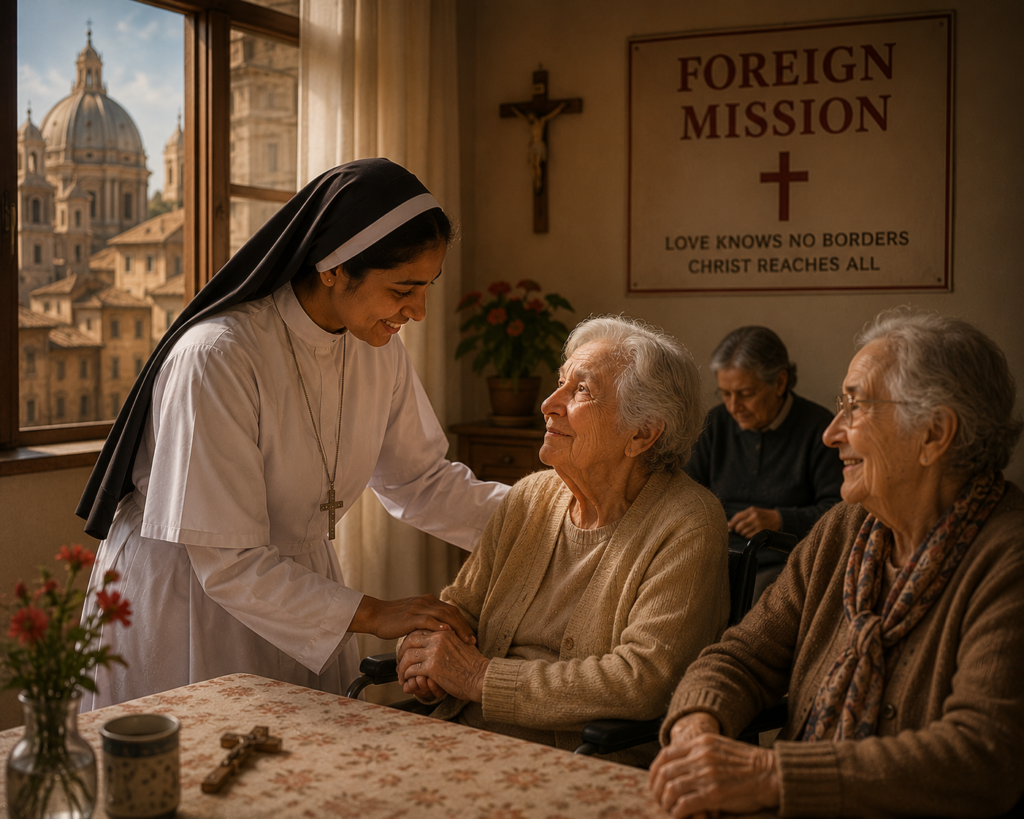
Today, the Mananthavady Province stands as a vibrant and growing community with 241 members and 39 houses spread across multiple dioceses. Its presence extends across the dioceses of Mananthavady, Mandya and Bhadravati in India, Cologne in Germany, and Modena and Fabriano in Italy, reflecting its truly wide and international mission.
In 1988 the province, in her infancy leaving behind the cool climate and attractive scenery of the homeland, made its first step into the Rajasthan desert out of mission thrust.
In 1988 the province, in her infancy leaving behind the cool climate and attractive scenery of the homeland, made its first step into the Rajasthan desert out of mission thrust.